
The Korean BBQ Boom: Why Smart Business Owners Are Taking Notice
Korean BBQ has exploded from a niche cultural export into one of the fastest-growing restaurant concepts worldwide. In ASEAN countries alone, the number of Korean restaurants has surged to nearly 4,890 locations – a remarkable 35% increase – while major chains like GEN Korean BBQ posted $208.4 million in revenue in 2024, up 15.1% year-over-year.
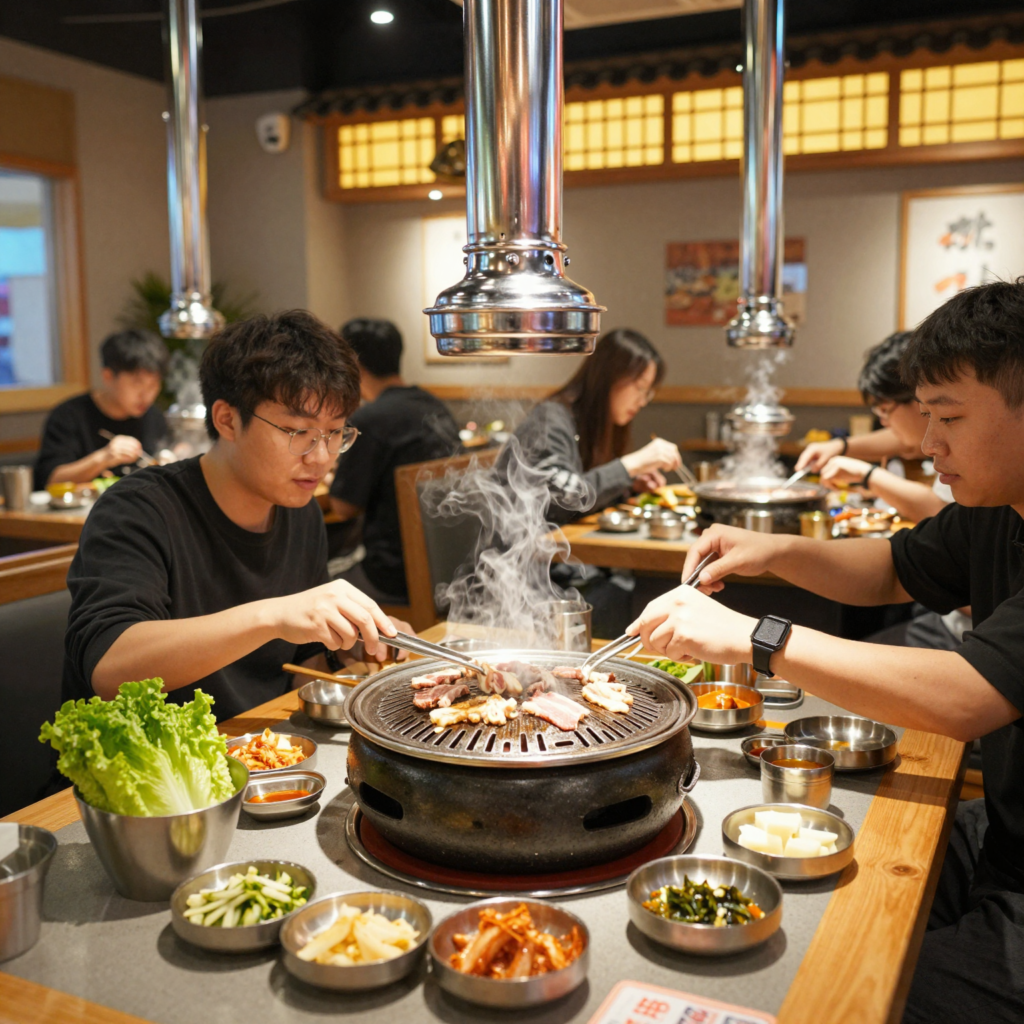
But here’s what most aspiring restaurateurs don’t realize: understanding how a Korean BBQ works is fundamentally different from opening a standard restaurant. Korean BBQ is not just food – it’s an immersive dining experience where guests become chefs at their own table, grilling marinated meats over high-heat burners built directly into the dining surface.
This interactive format demands specialized Korean BBQ restaurant equipment, from tabletop gas grills and heat-resistant cookware to dedicated exhaust hoods capable of capturing smoke directly at the source. Every element, from the commercial grill setup to the seating layout, must be engineered with precision.
Perhaps the most critical – and expensive – component is the Korean BBQ ventilation system. Unlike conventional restaurants, a Korean BBQ operation generates continuous smoke, grease-laden vapors, and intense radiant heat at every table. Wall-mounted or ceiling-suspended exhaust hoods with multi-stage filtration (including oil traps and activated charcoal filters) are not optional upgrades; they are regulatory necessities that can reduce cleaning downtime by up to 30% while ensuring customer comfort and fire safety compliance.
Industry data underscores the opportunity: the Korean BBQ grill equipment market is projected to grow at a 6.6% CAGR through 2033, driven by rising global demand. Yet for every successful opening, there are stories of operators who underestimated the technical demands of this concept.
The bottom line: understanding the mechanics of Korean BBQ operations is critical for any business owner considering this profitable but equipment-intensive concept. Master the infrastructure, and you unlock one of the most exciting growth opportunities in modern dining.
Gas vs Charcoal vs Electric Korean BBQ Grills: Which Is Right for Your Business?
Choosing the right grill type is the single most important equipment decision you’ll make as a restaurant owner. Whether you prioritize authentic smoky flavors or streamlined operations, this Korean BBQ grill comparison breaks down every critical factor – from upfront costs to daily operating expenses – so you can invest with confidence.
Side-by-Side Comparison Table
| Feature | Gas Grill | Charcoal Grill | Electric Grill |
|---|---|---|---|
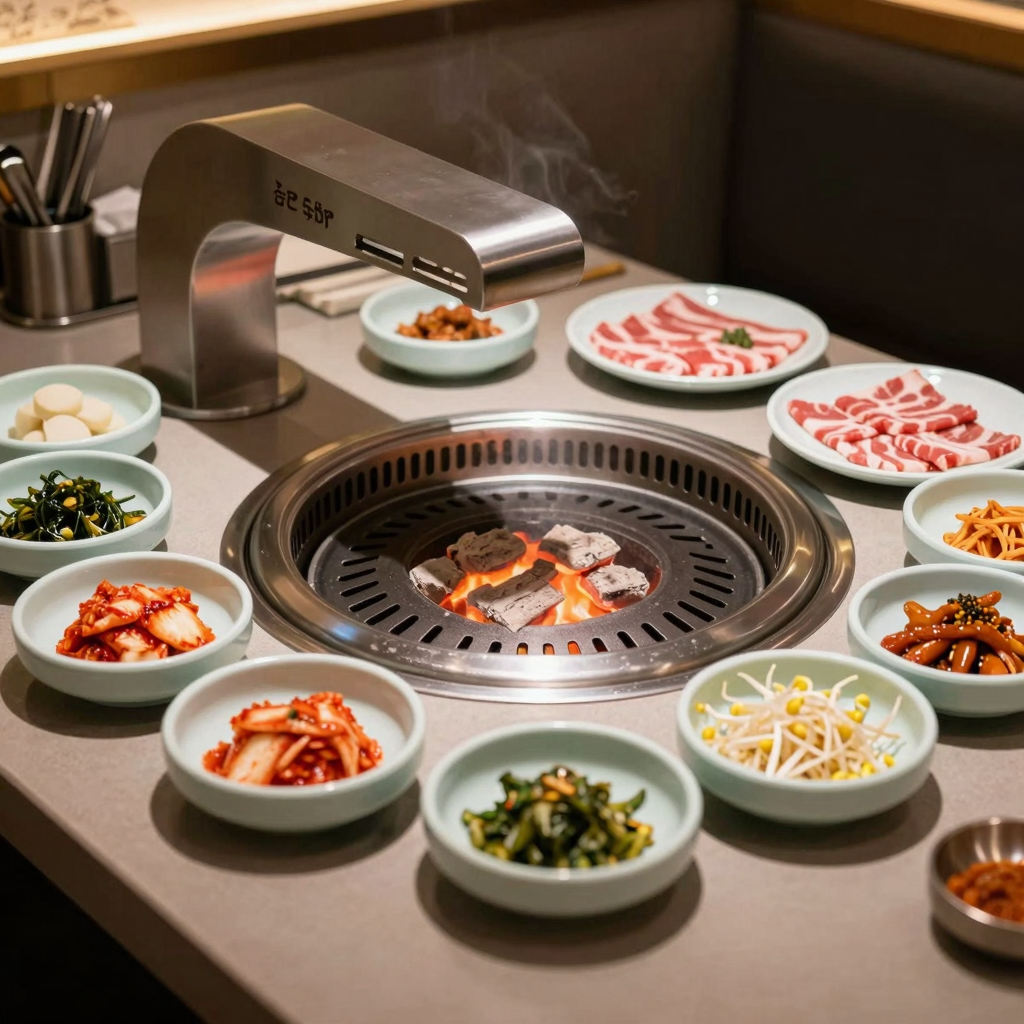
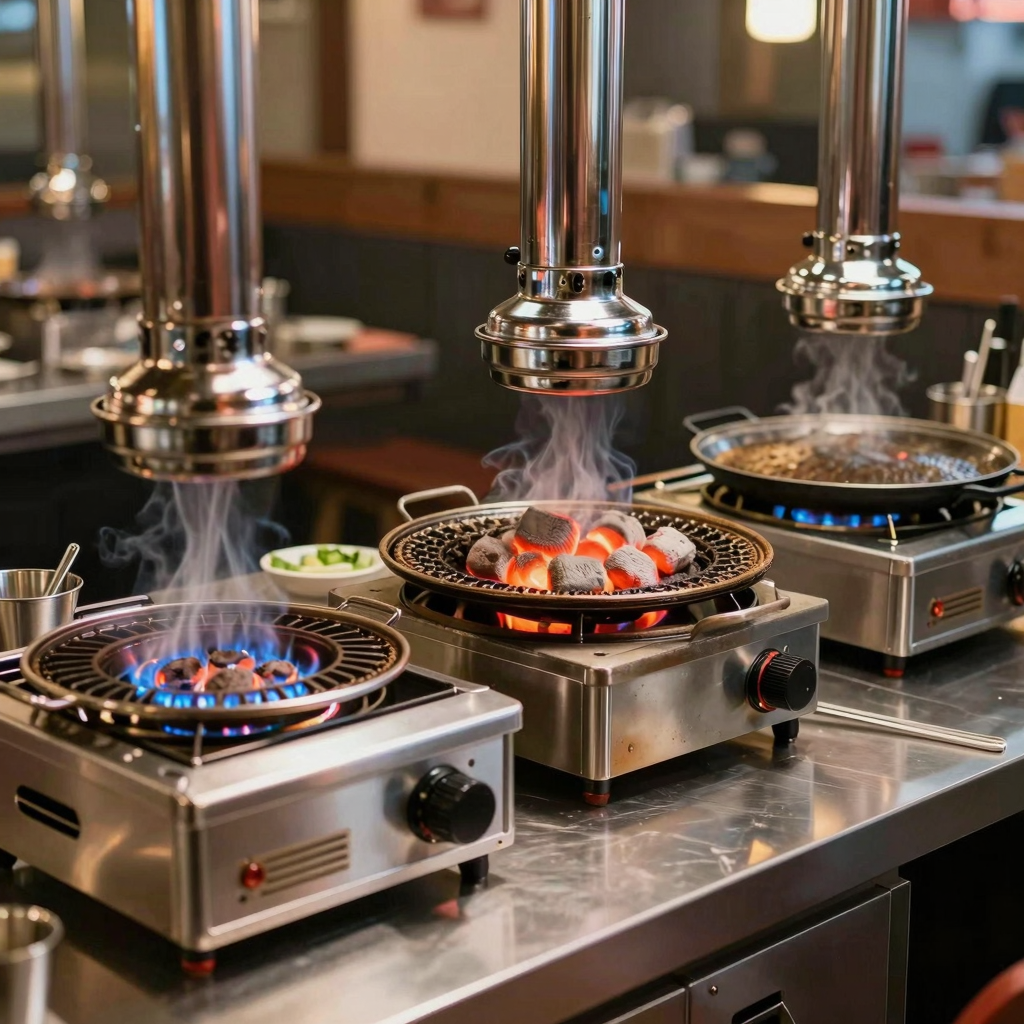
| Heat Source | Propane or natural gas burned through burners beneath ceramic or metal plates. Heats up in 5-7 minutes, offering instant temperature control. | Lump charcoal or briquettes ignited manually. Requires 15-20 minutes to reach cooking temperature and is harder to adjust on the fly. | Electrical heating elements embedded in the cooking surface. Plugs into a standard outlet and reaches temp in 3-5 minutes, but max heat is usually lower than gas or charcoal. |
| Initial Cost | Commercial models range from $480 to $1,200 depending on BTU output and number of burners. Mid-range investment for a durable, high-volume unit. | Commercial charcoal grills cost $350 to $1,900, with heavy-duty restaurant-grade units at the higher end. Entry-level options are affordable but may lack longevity. | Tabletop commercial electric grills start as low as $60 to $200 for basic models. Premium countertop units with higher wattage run $500-$800. Lowest upfront cost of the three. |
| Operating Cost Per Hour | $0.75-$1.20 per hour using natural gas (approx. 0.6-0.8 therms at $1.30/therm). Propane runs slightly higher. Most fuel-efficient for continuous all-day cooking. | $3.50-$8.00 per hour depending on charcoal consumption (1.5-3 lbs/hour at $1.50-$2.50/lb). Highest fuel cost due to consumable charcoal and ongoing ash disposal supplies. | $0.10-$0.30 per hour based on average commercial electricity rates (1500W-3000W units). Cheapest to run per hour, but heating elements may wear out faster, adding replacement costs over time. |
| Flavor Profile | Clean, consistent heat with minimal flavor transfer. Works well for marinated meats like bulgogi, but lacks the smoky char traditionalists expect. | Rich, smoky aroma with authentic char marks that customers associate with traditional Korean BBQ. The smoke itself becomes part of the dining experience and ambiance. | Neutral flavor with no smoke or char. Meat cooks evenly but lacks the grilled depth that defines Korean BBQ. Best suited for hot pot combos or lighter menu options. |
| Smoke Output | Moderate smoke from dripping juices hitting the heat deflectors. Requires a ventilation hood rated for moderate smoke in most commercial kitchens. | High smoke output – this is a feature, not a bug. Expect heavy smoke that demands a powerful exhaust system and frequent duct cleaning to meet fire codes. | Very low smoke output. Ideal for indoor or tabletop use where ventilation is limited. Many electric models market themselves as “smokeless” for this reason. |
| Maintenance Frequency | Low to moderate. Clean grease trays and burners weekly; inspect gas lines quarterly. With proper care, a commercial gas grill lasts 5-10 years. | High. Ash must be emptied after every service. Grates need scrubbing to remove carbon buildup. Chimney and ventilation ducts require monthly deep cleaning due to creosote accumulation. | Low. Wipe down the non-stick surface after each use. No fuel storage or ash handling needed. However, heating elements may need replacement every 1-2 years under heavy commercial use. |
| Fire Risk Level | Moderate. Gas leaks are the primary concern. NFPA reports gas grills as the most common source of grill-related fires, but proper installation and regular line checks mitigate this risk significantly. | High. Loose embers, ash disposal, and grease flare-ups pose serious fire hazards. Requires fire-rated flooring, non-combustible surroundings, and a Class K extinguisher within 30 feet per FDA Food Code guidelines. | Low to moderate. No open flame reduces fire risk, but faulty wiring and overloaded circuits can cause electrical fires. Over 60% of electric grills tested by Consumer Reports showed safety issues, so choose UL-listed models only. |
| Best For (Business Type) | High-volume Korean BBQ restaurants with a diverse menu. Ideal for all-you-can-eat Korean BBQ operations where speed, consistency, and low per-plate cost are critical to profitability. | Traditional, experience-driven Korean BBQ spots where customers expect authentic charcoal flavor and are willing to wait. Perfect for restaurants that also offer Korean BBQ and hot pot combos where the grill is part of the show. | Small-space restaurants, food courts, or tabletop BBQ concepts with limited ventilation. Also a strong choice for establishments pairing Korean BBQ with shabu-shabu where cooking at the table needs to be clean and fuss-free. |
Which Grill Should You Choose?
For most business owners launching a Korean BBQ concept, gas grills offer the best balance of operating cost, convenience, and versatility. The hourly fuel savings compared to charcoal can add up to thousands of dollars annually in a busy restaurant. However, if your brand identity revolves around traditional Korean BBQ culture, the higher cost of charcoal is a worthwhile investment – customers will taste the difference.
Electric grills work well as a secondary option for lunch rushes, smaller locations, or combo concepts where tabletop cooking needs to be quick and smoke-free. Many successful restaurants use a hybrid approach: gas for the main kitchen line and electric for tableside service.
Whichever type you choose, invest in proper ventilation, train your staff on fire safety protocols, and factor in local fire code requirements before making the final purchase.
The Hidden Hero: Commercial Ventilation Systems for Korean BBQ
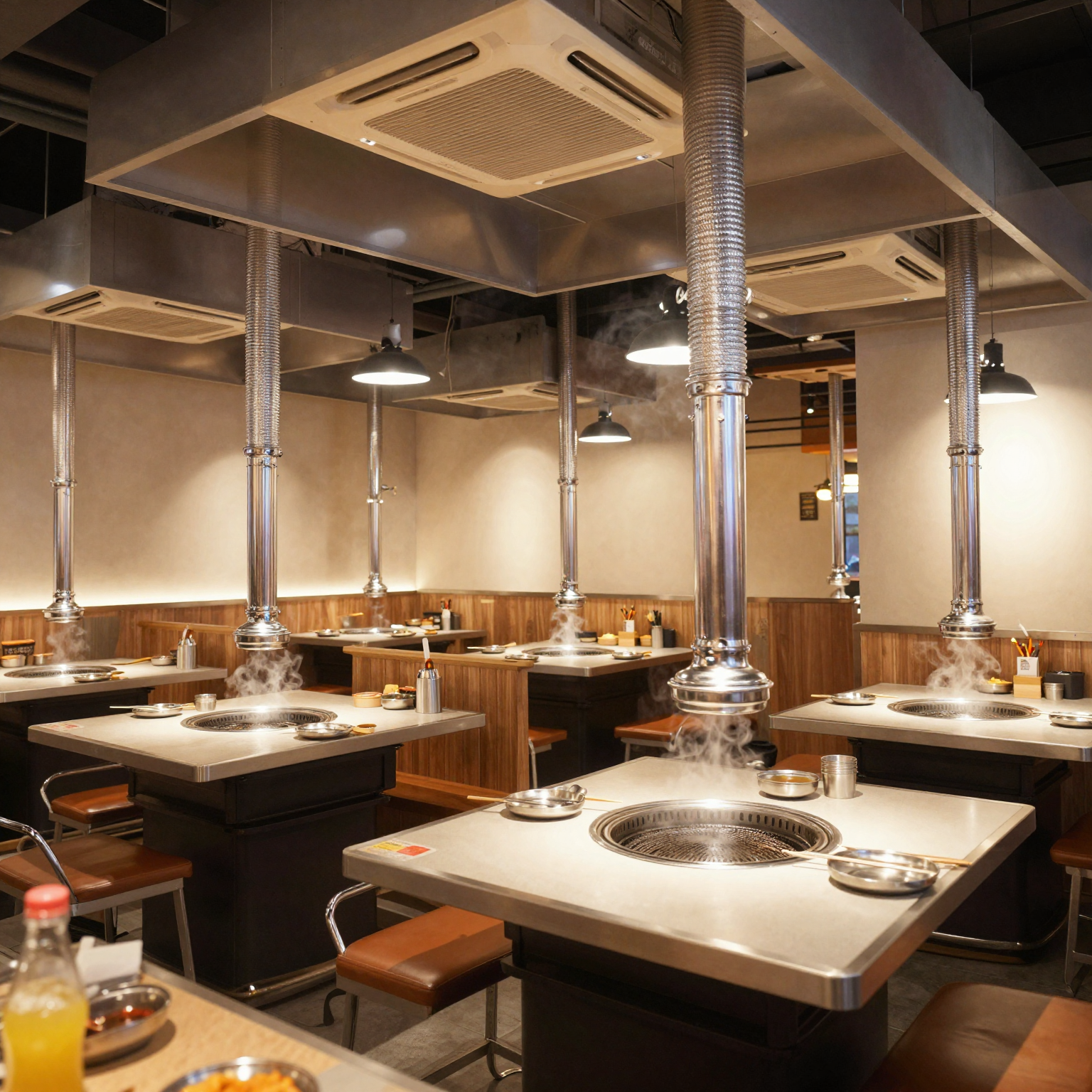
Walk into any authentic Korean BBQ restaurant, and the first thing you’ll notice – or rather, won’t notice – is the smoke. While tabletop grills sizzle with marinated beef, pork belly, and spicy chicken, patrons breathe clean air, their clothes emerge fresh, and the dining room remains pristine. That invisible magic is the work of a commercial ventilation system, which is arguably the most critical – and most expensive – infrastructure investment in any Korean BBQ establishment.
Why Korean BBQ Produces 3-5x More Smoke Than Standard Cooking
Korean BBQ presents a unique ventilation challenge. Unlike a standard restaurant kitchen where cooking happens in a back-of-house kitchen, Korean BBQ brings the heat directly to the dining table. Patrons cook raw marinated meats on gas or charcoal grills embedded in their tables at temperatures exceeding 500°F. The marinades – often packed with sugar, soy sauce, garlic, and sesame oil – caramelize and smoke intensely upon contact with hot surfaces. The result is a volume of smoke, grease-laden vapors, and airborne particulates that experts estimate at 3 to 5 times greater than what standard restaurant cooking produces.
This isn’t just an aesthetic concern. Without proper exhaust, smoke permeates upholstery, clings to walls, triggers fire alarms, and creates a respiratory hazard for guests and staff. As the National Fire Protection Association (NFPA) Standard 96 makes clear, any commercial cooking operation producing grease-laden vapors requires a dedicated, engineered ventilation system.
CFM Requirements: It’s All About the Math
Ventilation power is measured in CFM (cubic feet per minute) – the volume of air an exhaust fan moves each minute. For Korean BBQ, the requirements are substantial.
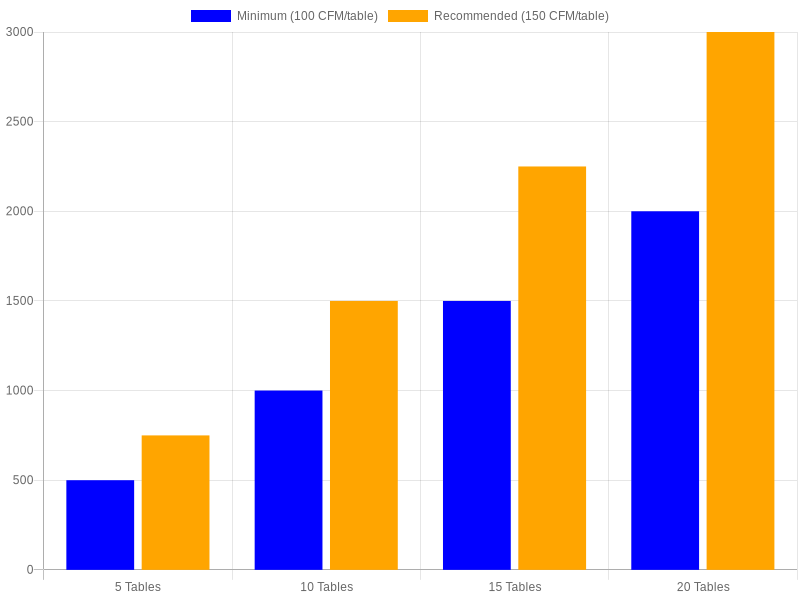
According to ASHRAE (American Society of Heating, Refrigerating and Air-Conditioning Engineers) standards and industry best practices, Korean BBQ restaurants require a minimum of 100 CFM per table, with many operators opting for 120-150 CFM per table to account for peak cooking times and variable grill usage. Here’s how that scales:
| Number of Tables | Minimum CFM Required (100 CFM/table) | Recommended CFM (150 CFM/table) |
|---|---|---|
| 5 Tables | 500 CFM | 750 CFM |
| 10 Tables | 1,000 CFM | 1,500 CFM |
| 15 Tables | 1,500 CFM | 2,250 CFM |
| 20 Tables | 2,000 CFM | 3,000 CFM |
A 20-table Korean BBQ restaurant operating at the recommended level needs to move 3,000 cubic feet of air per minute – roughly the volume of a small house – just to keep the dining room clear. This requires industrial-grade exhaust fans, properly sized ductwork, and strategically placed hoods. Skimping here means smoke settles before extraction, violating fire codes and driving customers away.
You can learn more about how these systems support different dining formats in our guide to Korean BBQ and hot pot restaurant setups.
Downdraft vs. Overhead Hoods: Two Schools of Thought
Korean BBQ ventilation generally falls into two categories, each with distinct advantages:
Overhead Commercial Hoods – These are the large, canopy-style exhaust hoods suspended above tables. They capture rising smoke and heat through natural convection and powerful suction. Overhead hoods offer exceptional smoke capture efficiency and can serve multiple tables with a single large unit. However, they require higher ceilings (typically 8-10 feet minimum), can dominate the restaurant’s visual aesthetic, and may feel imposing in smaller spaces.
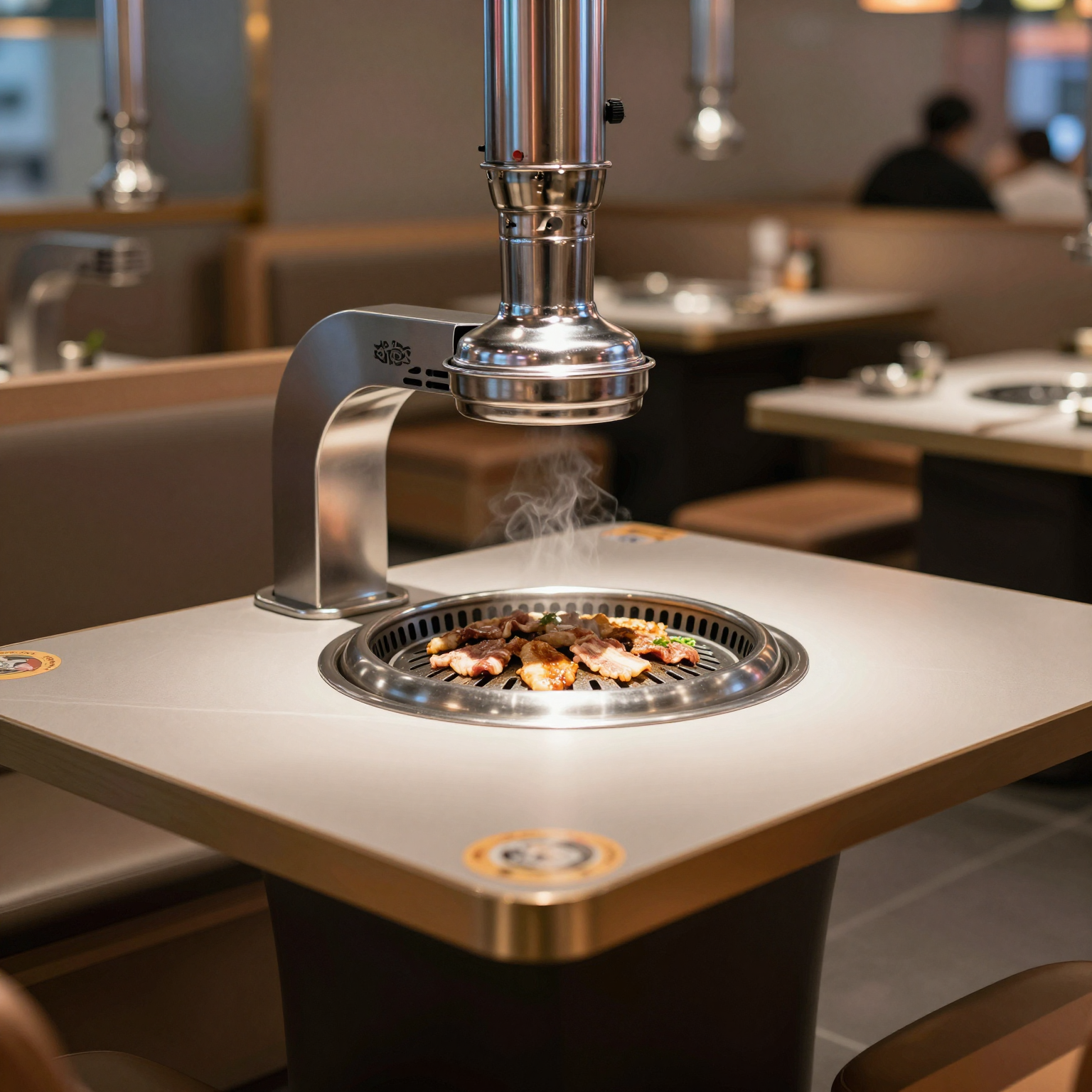
Downdraft Ventilation (Built-In) – Integrated directly into the grill table, downdraft systems pull smoke downward through vents surrounding the cooking surface. Advocates praise downdraft systems for preserving unobstructed sightlines and a cleaner tabletop appearance. They work well in spaces with lower ceilings where overhead hoods aren’t practical. However, downdraft systems generally require more powerful fans to overcome the natural upward movement of hot air and can be costlier to install and maintain.
Many modern Korean BBQ restaurants deploy a hybrid solution – overhead hoods for primary smoke capture paired with telescopic table-mounted exhaust arms for localized extraction at each grill. This dual-layer approach is widely considered the gold standard.
Fire Suppression Integration: The Ansul System
Korean BBQ restaurants operate open flames at every table. NFPA 96 mandates that any commercial cooking equipment producing grease-laden vapors must be protected by an automatic fire suppression system. The industry-standard solution is the Ansul R-102 system, a UL-listed and FM-approved fire suppression technology.
Here’s how it works: Heat-activated fusible links are positioned above each cooking surface. When temperatures reach approximately 350°F (177°C) – indicating a grease fire – the links melt, triggering automatic release of a liquid extinguishing agent (ANSULEX) that rapidly suppresses flames while simultaneously cooling hot surfaces to prevent re-ignition. The system also automatically shuts off gas or electrical power to the cooking equipment.
Ventilation and fire suppression are not separate systems – they must be designed to work in concert. The exhaust hood houses the fusible links and nozzles. The fan speed can be interlocked with suppression activation. This is why companies like Zoomlion, which specialize in high-tech fire safety and integrated equipment solutions, have become valuable partners for Korean BBQ operators planning new buildouts or retrofits.
Local Fire Code Compliance: No Room for Shortcuts
Ventilation compliance for Korean BBQ restaurants is governed by a layered framework:
- NFPA 96 – The national standard for ventilation control and fire protection of commercial cooking operations
- International Mechanical Code (IMC) – Governs duct construction, clearance to combustibles, and exhaust rates
- Local municipal codes – Often more stringent than national standards, with specific requirements for grease duct cleaning frequency, hood clearance distances, and system testing
Violations can result in fines, forced closure, insurance denial, or catastrophic fires. Many jurisdictions now require annual third-party inspections of exhaust systems and fire suppression equipment. Business owners should work closely with a licensed mechanical engineer and a certified fire protection contractor during the design phase.
For operators expanding or opening new locations, understanding these requirements is key. Check out our dedicated section on all-you-can-eat Korean BBQ in Oakland to see how different venues approach layout and ventilation.
The Bottom Line
A properly designed ventilation and fire suppression system for a Korean BBQ restaurant typically represents 15-25% of total construction costs – far higher than for a standard restaurant. But this isn’t an expense to be minimized; it is the invisible infrastructure that makes the entire experience possible. In a cuisine defined by fire, smoke, and sizzle, the true hero isn’t the grill – it’s the system that keeps the flames safe and the air clean, protecting both patrons and property with every cubic foot it moves.
Estimated Ventilation CFM Requirements by Korean BBQ Table Count
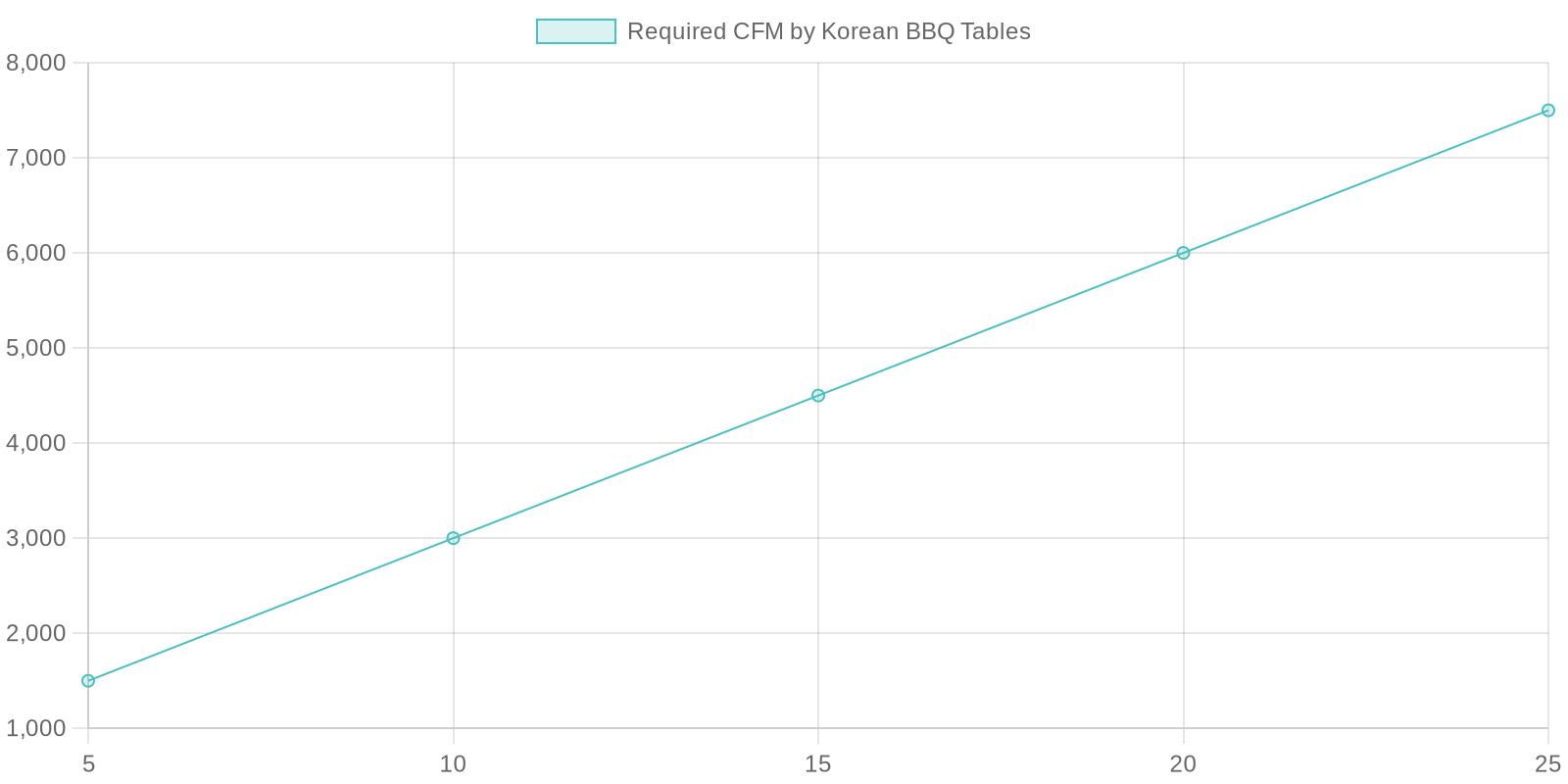
Caption: Proper ventilation sizing is not optional – it’s a fire code and customer comfort requirement. Based on industry standards recommending approximately 300 CFM per table for Korean BBQ setups, the required airflow scales linearly with the number of tables. These figures account for smoke extraction, grease capture, and heat removal needed to comply with NFPA 96 commercial kitchen ventilation standards. Undersizing your ventilation system can lead to fire hazards, poor air quality, and an uncomfortable dining experience that drives customers away.
| Number of Korean BBQ Tables | Required CFM |
|—|—|—|
| 5 | 1,500 |
| 10 | 3,000 |
| 15 | 4,500 |
| 20 | 6,000 |
| 25 | 7,500 |
Data source: Industry best practices for commercial kitchen hood ventilation (NFPA 96 compliance guidelines).
Fire Safety & Compliance: What Every Korean BBQ Owner Must Know
Running a Korean BBQ restaurant comes with unique fire safety challenges that go far beyond those of a standard eatery. Between sizzling tabletop grills, high-fat marinated meats, and open-flame cooking, your kitchen and dining room generate conditions that demand rigorous fire prevention protocols. Here is what every Korean BBQ owner needs to know to stay compliant, protect their staff, and safeguard their investment.
1. Grease Fire Risks: The Hidden Danger in Korean BBQ
Korean BBQ’s signature style – cooking fatty cuts of beef (like brisket and short rib), pork belly (samgyeopsal), and marinated meats at high heat directly on tabletop grills – creates intense grease aerosolization. As smoke rises, grease particles accumulate inside hood ducts, filters, and exhaust fans. According to the National Fire Protection Association (NFPA), grease buildup in commercial kitchen ducts is the leading cause of restaurant fires. The Los Angeles County Fire Department specifically flags Korean BBQ establishments as high-risk due to the combination of open-flame grills and high-fat cooking. If a grease fire ignites, using water is catastrophic – it creates an explosive fireball. Only Class K wet chemical extinguishers and properly maintained suppression systems can handle these fires safely.
2. Required Fire Suppression Systems
Every Korean BBQ kitchen must be equipped with a Type I hood system featuring an Ansul (wet chemical) fire suppression system that meets NFPA 17A and UL 300 standards. These systems use heat-sensitive detection tubing (fusible links or polymer tubes) that automatically activates when temperatures exceed approximately 260°F (127°C), releasing a wet chemical agent through nozzles positioned above the grill. The system also triggers an automatic gas shutoff to cut fuel supply. Key requirements include:
- Type I hood over all cooking equipment (grills, burners)
- Wet chemical extinguishing system (Ansul or UL 300-listed equivalent)
- Manual pull station for emergency activation
- Automatic fuel/gas shutoff valve linked to the suppression system
- Class K fire extinguishers mounted within 30 feet of all cooking areas
“Korean BBQ operations are one of the highest-risk commercial cooking environments because you’re effectively running an open-flame grill in the middle of your dining room. I’ve seen too many owners cheap out on hood ventilation or skip quarterly duct cleaning. That’s not just a code violation – it’s a life safety issue. A proper Type I hood with an Ansul wet chemical system, inspected and tagged annually, is non-negotiable. Pair that with a well-maintained exhaust system and you’ve got your first and best line of defense against a devastating grease fire.”
- David Chen, Fire Code Official, Los Angeles County Fire Department (25 years of service)
3. Local Fire Code Inspection Checklist for Korean BBQ Restaurants
Fire marshals inspecting Korean BBQ restaurants will look for these critical items. Below is a checklist based on NFPA 96 and NFPA 101 standards, with additional requirements specific to Korean BBQ operations:
| Inspection Item | Requirement | Frequency |
|---|---|---|
| Type I hood & wet chemical system | Installed, tagged, and certified per NFPA 17A | Annual professional inspection |
| Grease duct cleaning | No visible grease buildup >1/8 inch | Quarterly professional cleaning |
| Class K fire extinguishers | Accessible within 30 ft of cooking area | Monthly visual check; annual professional service |
| Automatic gas shutoff | Functional and linked to suppression system | Tested during annual inspection |
| Hood filters in place | All filters installed, no gaps | Daily cleaning; replaced when damaged |
| Emergency exits | Unobstructed, clearly marked with exit signage | Ongoing compliance |
| Grease traps | Cleaned and functioning | Monthly inspection |
| Staff fire training records | Written documentation of training | Upon hire and annually thereafter |
| Clearance around grills | Non-combustible materials within 18 inches | Initial installation verification |
4. Staff Training Requirements for Fire Response
NFPA 96 mandates that all commercial kitchen operators implement a written fire safety program with documented staff training. For Korean BBQ restaurants, this is especially critical because tabletop grills mean fire risks exist not just in a closed kitchen but in the dining area itself. Training must cover:
- Identifying fire hazards – spotting grease buildup, faulty wiring, or improper fuel storage
- Using Class K fire extinguishers – mastering the PASS technique (Pull, Aim, Squeeze, Sweep)
- Automatic suppression system awareness – understanding that the system will trigger gas shutoff and knowing what to do afterward
- Emergency evacuation procedures – knowing when to fight a small fire versus evacuating immediately
- Dining room protocols – safely guiding guests away from tabletop fires without panic
All training must be documented with employee sign-off and refreshed at least annually.
5. Insurance Implications: Korean BBQ vs. Standard Restaurants
Insurance underwriting for Korean BBQ restaurants is distinctly different from standard restaurants. Insurers classify Korean BBQ as a higher-risk operation due to three specific factors: open-flame cooking in the dining area, elevated grease production from high-fat meats, and increased smoke/heat output requiring specialized ventilation. According to The Hartford and Next Insurance, underwriters evaluate:
- Cooking equipment type – tabletop grills and open flames increase fire probability
- Ventilation and suppression systems – modern, certified systems can reduce premiums
- Grease management practices – documented cleaning schedules lower risk ratings
- Claims history – past fire or grease-related claims significantly impact rates
- Staff training programs – robust training demonstrates proactive risk management
Korean BBQ owners can expect higher premiums than standard restaurants but restaurants with certified Type I hood systems, regular professional duct cleaning, and documented staff training programs qualify for more favorable rates. Some insurers may even require proof of quarterly hood and duct cleaning as a policy condition.
Building a Culture of Safety
Fire safety in Korean BBQ isn’t just about passing an inspection – it’s about protecting your guests, your team, and your business. The equipment industry has come a long way in advancing fire suppression technology. Since 1992, Zoomlion has built a legacy of equipment safety and innovation, developing fire apparatus and suppression technologies that have set global standards with over 200 patents and products used in high-risk environments worldwide. The same principle applies to your restaurant: invest in quality suppression systems, commit to rigorous maintenance schedules, and train your staff thoroughly.
If you are planning or running a Korean BBQ venture, prioritizing fire compliance from day one will save you money, stress, and potentially lives. For more on how Korean BBQ restaurants operate safely, explore our guide on all-you-can-eat Korean BBQ in Oakland to see how top establishments balance guest experience with safety, or check out Korean BBQ Las Vegas for more operational insights.
Fire Safety: A Non-Negotiable Priority for Korean BBQ Restaurants
Operating a Korean BBQ restaurant means bringing the drama and flavor of tabletop, open-flame cooking directly to your guests. But with that immersive dining experience comes a distinct set of hazards that standard restaurant kitchens simply do not face. The proximity of live flame to diners, combined with high-volume grease and smoke output, demands a level of fire safety preparedness that goes well beyond code minimum.
“Korean BBQ restaurants operate in a uniquely high-risk category because you have open flames burning just inches from patrons who are actively handling food and utensils. Unlike a closed kitchen where fire is contained behind a wall, the combustion source is right there on the table. I’ve inspected hundreds of these establishments, and the ones that cut corners on ventilation hoods or suppression systems are gambling with lives. A properly rated hood system with integrated Ansul-style fire suppression isn’t a luxury upgrade – it’s a life-safety requirement that every owner must treat as their single most critical investment.”
- James Park, Fire Safety Consultant, 20+ years of restaurant inspection experience
Industry data underscores the urgency of his warning. Research from commercial kitchen safety analysts indicates that restaurants operating open-flame cooking without ducted hoods and automatic fire suppression systems are 3.7 times more likely to experience a kitchen fire. During peak hours, ignition incidents in high-heat environments can rise by up to 60% when suppression systems are absent. For business owners exploring how to open or expand a Korean BBQ concept, understanding that proper ventilation and suppression are mandated by fire code – not optional – is the first step toward a safe and sustainable operation.
If you’re looking for established venues that prioritize both safety and authentic dining, explore our all you can eat Korean BBQ Oakland location or check out the Kogi Grill Largo menu – both designed with proper safety infrastructure in mind.
The Business Case: ROI of Proper Korean BBQ Equipment
For entrepreneurs exploring how does a korean bbq work for business operations, the upfront cost of equipment can feel daunting. But here’s the truth that separates thriving Korean BBQ restaurants from those that close within two years: the equipment you choose determines your entire financial trajectory.
Let’s break down the real numbers.
Initial Investment Breakdown
Opening a Korean BBQ restaurant requires a significant but calculated capital outlay. Here’s what industry data reveals about the core investment categories:
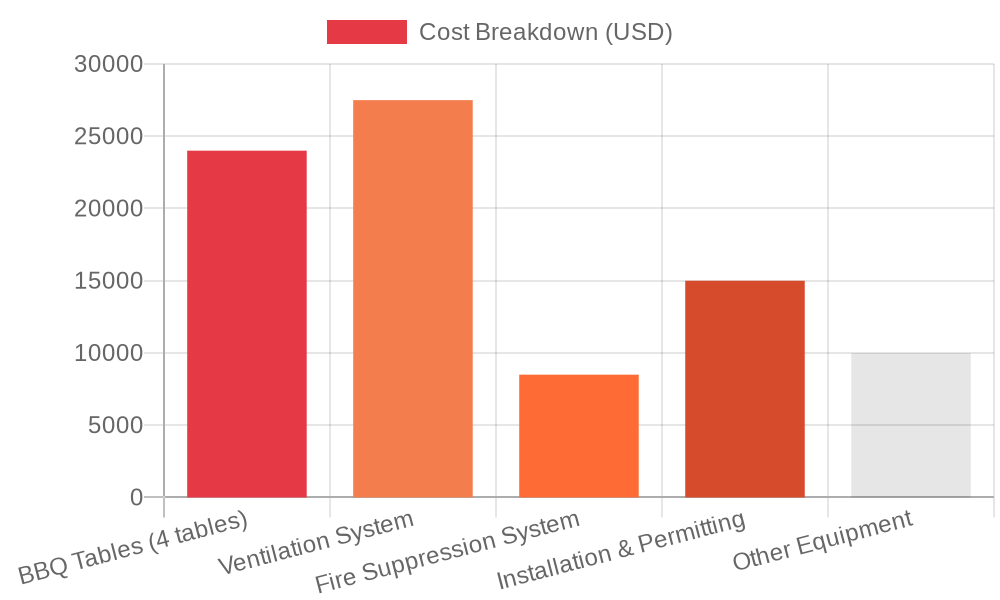
Source: Restaurant Owner Magazine, National Restaurant Association, IBISWorld (2024)
| Equipment Category | Typical Cost Range | Average Cost |
|---|---|---|
| BBQ Tables (per table) | $3,000 – $8,000 | $5,500 |
| Ventilation System | $15,000 – $40,000 | $27,500 |
| Fire Suppression System | $5,000 – $12,000 | $8,500 |
| Installation & Permitting | $10,000 – $20,000 | $15,000 |
| Grills, Utensils & Smallwares | $5,000 – $15,000 | $10,000 |
| Total Initial Equipment | $35,000 – $90,000 | $65,000 |
While the sticker price is substantial, the return on investment becomes clear when you examine operational metrics.
Table Turnover: Korean BBQ vs. Regular Dining
One of the most compelling financial arguments for Korean BBQ is table efficiency. While the interactive, cook-at-your-table experience means diners spend longer per seating compared to fast-casual, the per-table revenue dramatically outperforms standard restaurants:
| Metric | Regular Dining | Korean BBQ | Advantage |
|---|---|---|---|
| Average table turnover (dinner) | 1.5 – 2.0 turns | 1.5 – 2.5 turns | Comparable to better |
| Average check per person | $35 – $50 | $60 – $90 | +60-80% higher |
| Per-table daily revenue | $100 – $150 | $175 – $240 | +60-75% higher |
| Peak weekend per-table revenue | $180 – $220 | $250 – $300+ | +35% or more |
Source: National Restaurant Association 2024 Report, RestaurantOwner.com, Forbes Business Insights
The bottom line? A single Korean BBQ table can generate $180-$300+ per day. With just 10 tables turning 1.5 times during dinner, you’re looking at $2,700-$4,500 in nightly revenue – even before lunch service.
The Revenue Potential Per Table
Let’s do the math on a modest 10-table restaurant:
- Average per-person spend: $70
- Average party size: 4 people
- Per-table revenue per turn: $280
- Average dinner turns: 1.8
- Per-table daily revenue: $504
- 10 tables × $504 = $5,040 per dinner service
- Monthly dinner revenue (30 days): ~$151,200
With profit margins estimated at 25-35% for well-run Korean BBQ concepts, that single month of dinner service alone can recoup a significant portion of your equipment investment.
Maintenance Costs: The Ongoing Investment
Proper equipment requires ongoing care, but the costs are predictable and manageable:
| Maintenance Item | Frequency | Annual Cost |
|---|---|---|
| Professional duct/grease cleaning | Quarterly | $4,800 – $10,000 |
| Grate replacement (stainless steel) | 1-2 times/year | $300 – $1,600 |
| Filter replacements (HEPA/carbon) | 2 times/year | $300 – $800 |
| Full system inspection | Annually | $1,000 – $3,000 |
| Total Annual Maintenance | $6,400 – $15,400 |
Source: NFPA 96 Standards, RestaurantOwner.com maintenance survey
This translates to roughly $530-$1,280 per month – a fraction of what one table generates in a single evening.
The Hidden Cost of Cutting Corners
Here’s where many new operators get it dangerously wrong. Skimping on ventilation or fire suppression doesn’t just affect air quality – it has cascading financial consequences:
- Insurance premium hikes: Commercial property insurance premiums for restaurants have risen 28% on average over the past two years. Restaurants with poor ventilation or fire safety compliance face even steeper increases or outright policy denial.
- Shutdown risk: The NFPA reports that 67% of restaurant fires originate in the kitchen, with 85% involving dirty or poorly maintained exhaust systems. A single grease fire can lead to health department closure, repair costs averaging $50,000+, and months of lost revenue.
- Liability exposure: Inadequate fire suppression means you’re one spark away from a lawsuit. Without proper documentation of system maintenance, your insurance carrier can deny your claim entirely.
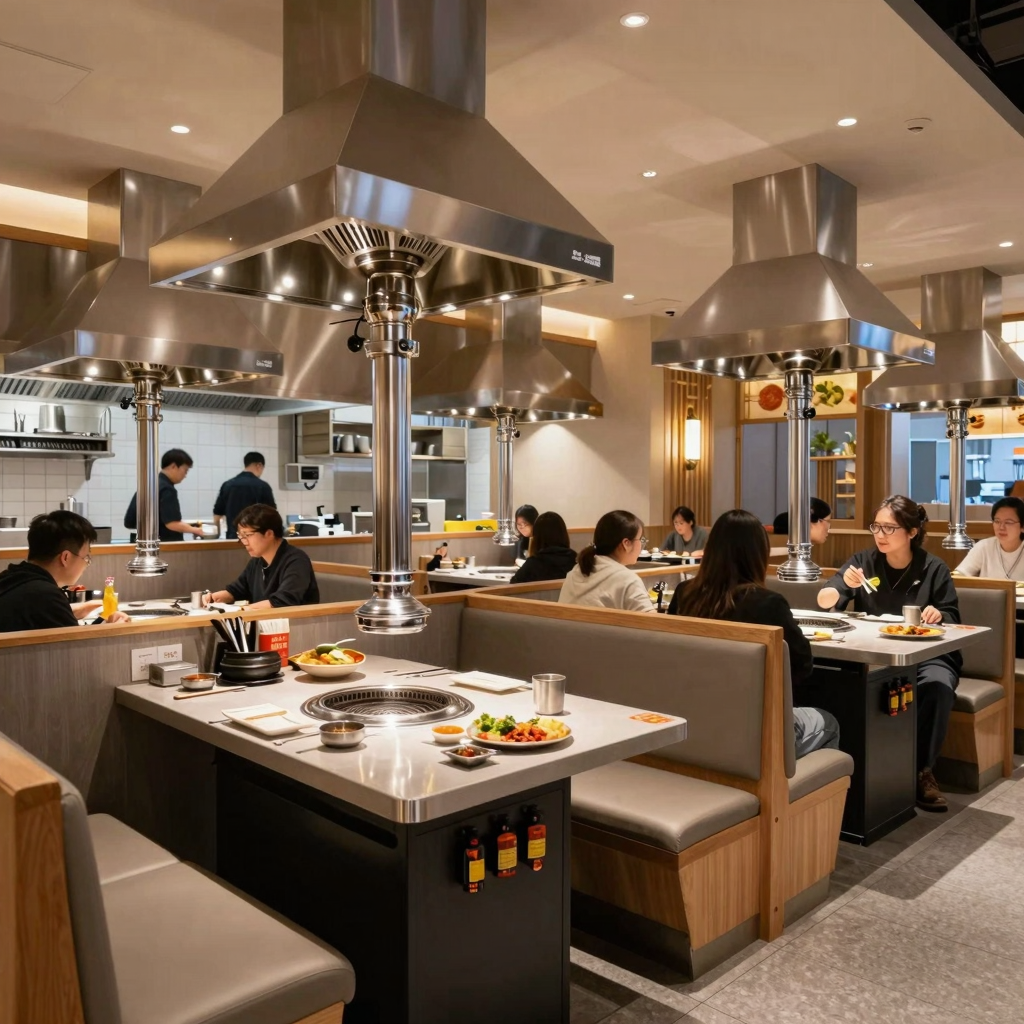
Professional-grade equipment creates the inviting, safe atmosphere that keeps customers coming back.
5 Hidden Costs of Buying Cheap Korean BBQ Equipment
Cutting corners on your initial equipment purchase creates a domino effect of hidden expenses. Here’s what you’re actually paying for:
- Frequent grate replacements – Low-cost grates warp, rust, and degrade within 6-12 months. Premium stainless steel grates last 5+ years. The math: cheap grates at $150 replaced four times = $600 vs. quality grates at $600 replaced once. You pay more in the long run.
- Higher utility bills – Substandard ventilation systems are inefficient, pulling 25-40% more energy to achieve the same airflow. That extra $300-$600/month in electricity adds up to $18,000-$36,000 over five years – more than a premium system costs upfront.
- Lost customer revenue – Poor smoke extraction creates an unpleasant, hazy dining environment. Dim visibility and lingering smoke odors drive down review scores and repeat visits. A single 3.5-star vs. 4.5-star rating can cost you 15-30% of potential revenue.
- Emergency repair premiums – Budget equipment breaks down during peak hours. Emergency weekend repair calls cost 2-3x standard rates, and a broken grill during Saturday dinner means $1,000+ in lost table revenue per hour of downtime.
- Insurance and compliance penalties – Inadequate systems mean higher premiums (20-40% more), risk of policy cancellation, and failure to pass health/fire inspections. A single failed inspection can trigger fines of $500-$5,000 plus mandated upgrades that cost more than doing it right the first time.
The 5-10 Year Verdict
When you understand how does a korean bbq work from a financial perspective, the choice becomes clear. Consider the total cost of ownership over a decade:
| Scenario | Cheap Equipment | Quality Equipment (e.g., Zoomlion) |
|---|---|---|
| Initial cost | $35,000 | $65,000 |
| 10-year maintenance | $75,000+ (repairs + replacements) | $64,000 – $154,000 (routine) |
| Insurance premiums (10 yrs) | $250,000+ (higher rates) | $200,000 (standard rates) |
| Revenue lost to downtime/repairs | $80,000 – $150,000 | Minimal |
| 10-Year Total Cost | $440,000+ | $329,000 – $419,000 |
| 10-Year Revenue Potential | Limited by equipment failure | Maximized |
Investing in quality equipment from reputable manufacturers protects your bottom line over the 5-10 year horizon. Brands like Zoomlion deliver ventilation and fire suppression systems built for the demanding Korean BBQ environment – engineered for efficiency, compliance, and longevity. The premium you pay upfront is dwarfed by the operating savings, reduced risk, and revenue reliability you gain.
Your Korean BBQ restaurant’s financial future is literally built into the equipment you choose. Don’t build on a shaky foundation.
Ready to explore the operational side of running a Korean BBQ restaurant? Check out our guide on all you can eat korean bbq oakland for real-world menu and pricing strategies that maximize your per-table revenue.
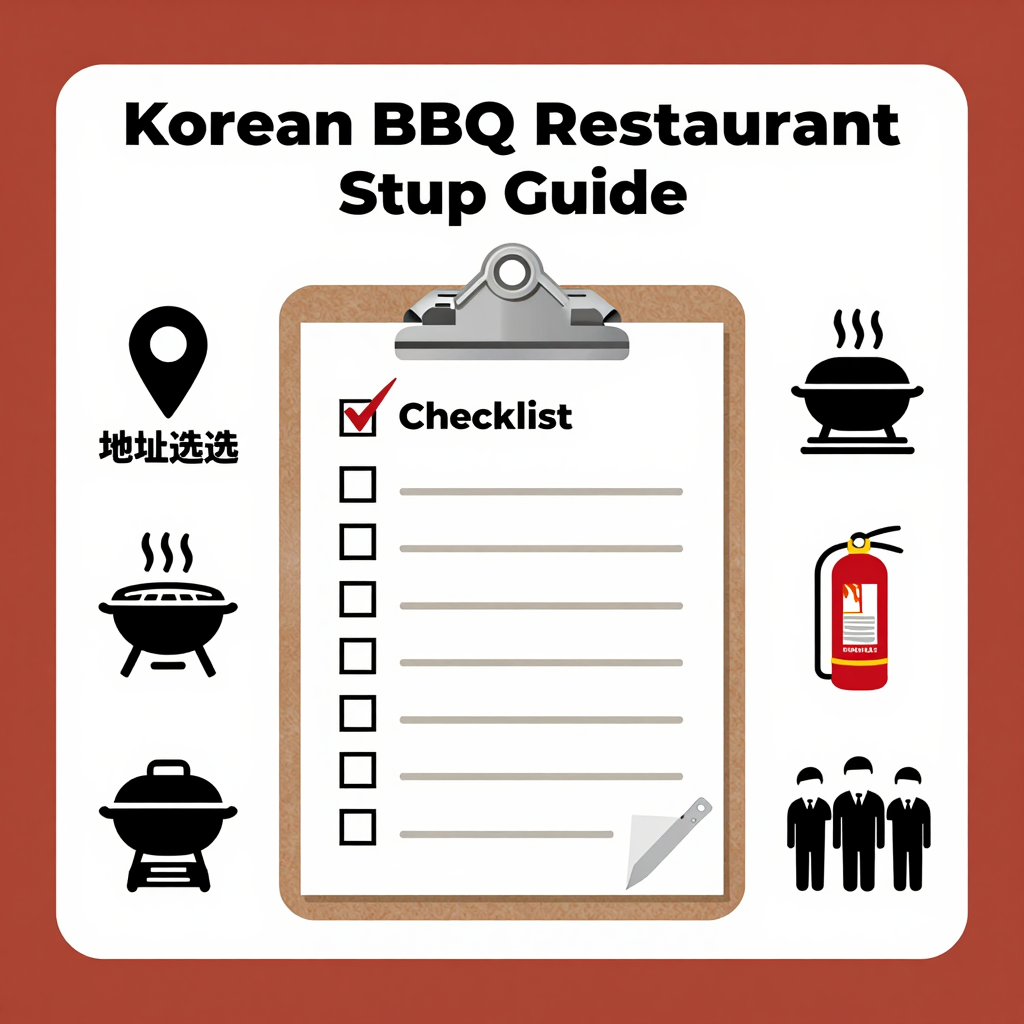
Your complete checklist for launching a successful Korean BBQ venture.
Opening a Korean BBQ restaurant is an exciting but complex undertaking. Unlike a standard eatery, this concept demands specialized ventilation, strict fire safety protocols, and unique floor plan considerations. This step-by-step Korean BBQ restaurant setup guide walks you through the critical stages from market research to your soft launch.
Step 1: Market Research and Concept Validation
Before signing any lease, you need to understand your local landscape. Conduct a competitive analysis of existing Korean BBQ spots within a 5-mile radius. Are they all-you-can-eat or à la carte? What’s their average Yelp rating? Identify gaps – for example, if no one nearby offers premium cuts or a Korean BBQ and sushi menu, that could be your niche. Use free tools like Google Trends and the U.S. Census Bureau to gauge demographic demand and disposable income in the area.
Step 2: Location Selection with Ventilation and Utility Considerations
Your location can make or break a Korean BBQ restaurant. Look for spaces with existing high-capacity electrical service (200+ amps), robust HVAC infrastructure, and easy access to grease trap maintenance. Ventilation is non-negotiable – you need a ducted hood system that vents directly outside per IMC (International Mechanical Code) standards. Avoid strip mall units that share HVAC with neighboring tenants, as smoke complaints can lead to lease violations. Also, verify with your local fire marshal that the space’s occupancy load supports tabletop grilling.
Step 3: Floor Plan Design – Table Spacing and Fire Code Egress
A Korean BBQ floor plan is not the same as a standard restaurant layout. Each table needs a dedicated overhead exhaust hood or a powerful downdraft system, so table placement must align directly under your ventilation grid. Maintain a minimum of 36 inches between tables for fire code egress paths and server access. Remember: each grilling table is a heat source, so keep a 24-inch clearance from any combustible wall or partition. Draft your layout using AutoCAD or a commercial kitchen design service, and submit it to the fire department for preliminary approval before construction begins.
Step 4: Equipment Procurement – Grills, Hoods, and Suppression Systems
This is where your budget gets serious. For a typical 40-seat Korean BBQ restaurant, expect to spend $30,000-$60,000 on ventilation alone. You’ll need:
Essential Equipment Checklist:
| Equipment | Typical Cost (Per Unit) | Key Specification |
|---|---|---|
| Commercial tabletop gas grill | $1,200-$3,500 | 30,000-50,000 BTU, stainless steel |
| Overhead canopy hood (ducted) | $4,000-$12,000 | Min 100 CFM per sq ft of hood face |
| Retractable K-hood (per table) | $2,500-$4,000 | Direct-connect to duct, UL 710 listed |
| Ansul fire suppression system | $3,500-$8,000 | Pre-engineered for commercial cooking |
| Grease trap | $1,500-$4,000 | 50+ GPM capacity, local code compliant |
This is also the right moment to understand how does a korean bbq work at the equipment level: guests cook raw proteins on a gas or charcoal grill built into the table, while an overhead or drop-down hood captures smoke and grease particles before they disperse. The hood connects to an exhaust fan on the roof, creating negative pressure that pulls smoke upward. A properly integrated fire suppression system (typically an Ansul or similar brand) sits above the hood and automatically discharges dry chemical or wet agent if flames reach the filter area. Order all equipment from certified commercial suppliers and verify UL/ETL listings before paying deposits.
Step 5: Installation and Inspection
Hire a licensed mechanical contractor to install your ventilation system – this is not a DIY job. The installation must follow the manufacturer’s specs and local codes. After installation, you’ll need three separate inspections: (1) the fire marshal inspects the suppression system and egress, (2) the health department checks grease traps and sanitation, and (3) the building department verifies structural and electrical work. Schedule these inspections in sequence; failing one can delay your opening by weeks. Keep a binder with all equipment manuals and warranty documents readily available for inspectors.
Step 6: Staff Training on Equipment Operation and Fire Safety
Your staff needs more than just serving skills – they must understand the equipment inside and out. Train every front-of-house team member on how to light the tabletop grills safely, how to recognize signs of grease buildup in the hood filters, and what to do if the fire suppression system activates (evacuate the immediate area, alert the manager, do NOT use water). Schedule a hands-on session with your fire suppression system vendor so staff can see a live demonstration. Consider offering all-you-can-eat Korean BBQ training sessions where new hires practice grilling timing and table service under real conditions. Document all training and have each employee sign off on fire safety protocols.
Step 7: Soft Launch and Menu Testing
Invite friends, family, and local food bloggers for a private soft opening week. This lets you stress-test your kitchen workflow, ventilation performance, and service timing without the pressure of full capacity. Monitor how quickly smoke clears between courses – if haze lingers, adjust hood fan speeds or table spacing. Collect feedback on everything from marinade sweetness to grill heat consistency. Use this data to refine portion sizes and pricing before your grand opening. Track your average table turn time; Korean BBQ service is inherently slower than standard dining, so aim for 90-120 minutes per table to optimize revenue without rushing guests.
Final Checklist Recap
- [ ] Market research and competitor analysis completed
- [ ] Location selected with proper utility capacity
- [ ] Floor plan approved by fire marshal
- [ ] All equipment ordered and delivered
- [ ] Ventilation and suppression systems inspected
- [ ] Staff fully trained on fire safety protocols
- [ ] Soft launch executed with documented feedback
Follow this Korean BBQ restaurant setup guide step by step, and you’ll build a restaurant that’s not only authentic and delicious but also safe, compliant, and built for long-term success.
5 Essential Equipment Checks Before Opening Each Day
Running a Korean BBQ restaurant means your equipment works harder than almost any other kitchen setup. Between the high-heat grill tables, gas lines, and heavy ventilation demands, a single missed inspection can lead to costly downtime – or worse, a safety incident. Here’s your non-negotiable daily checklist to keep your operation safe, compliant, and ready for service.
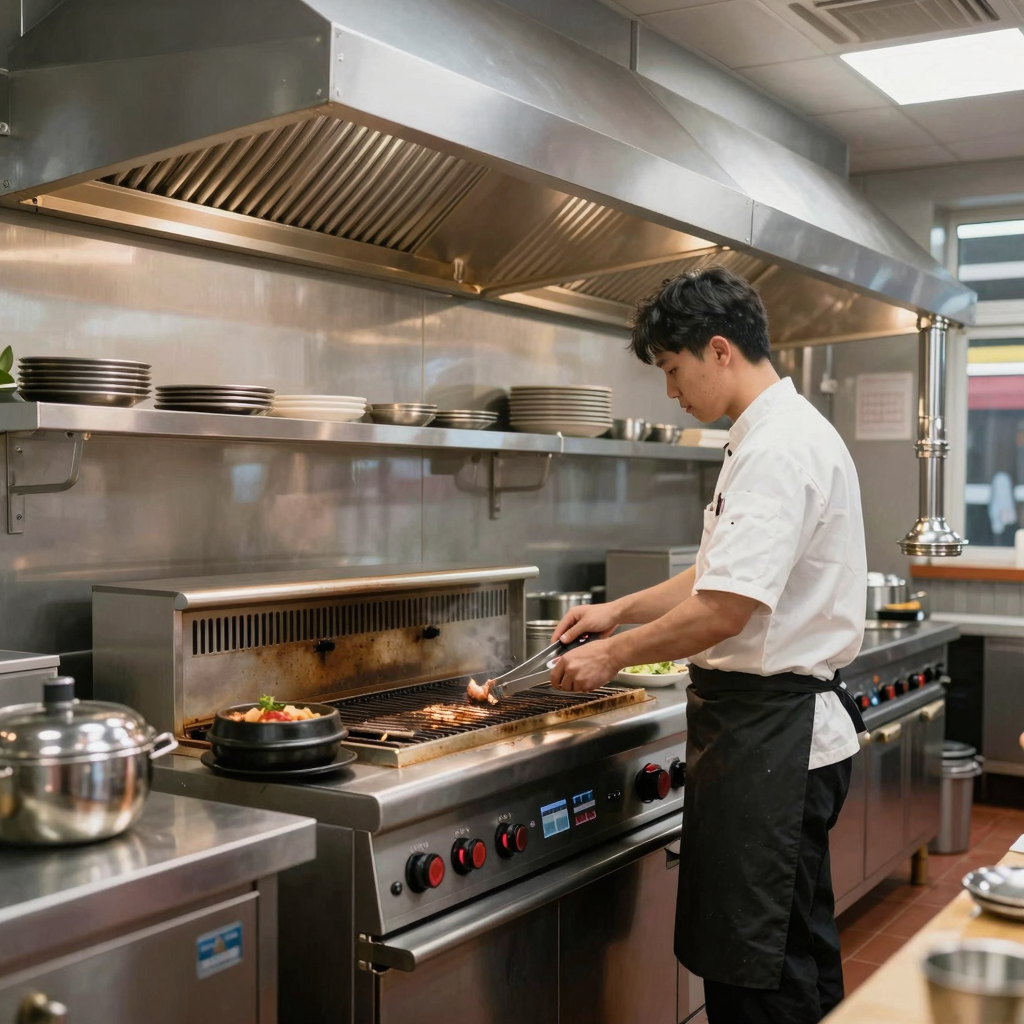
1. Inspect grill grates for residue buildup and even heating
Start every shift by examining the grill grates on every table. Carbonized food residue and grease buildup don’t just affect food quality – they create fire hazards and uneven cooking that frustrates guests. Scrape away debris and test each burner section to ensure consistent heat distribution across the entire surface. A quick visual inspection now saves you from mid-service flare-ups and unhappy customers.
2. Test ventilation hood airflow with a manometer or visual indicator
Your exhaust system is the lungs of a Korean BBQ restaurant. Industry standards under NFPA 96 require a minimum of 150 CFM per linear foot of hood, and high-heat operations like tabletop grills demand even more. Use a manometer to verify airflow is within range, or check your hood’s built-in visual flow indicator. If airflow is weak, don’t open – grease-laden air won’t evacuate properly, creating both fire and health code risks.
3. Verify fire suppression system readiness (pull pins, gauge pressure)
Your Ansul or wet-chemical fire suppression system is the last line of defense against a kitchen fire. Confirm that pull pins are intact and accessible, and check the pressure gauge on the agent tank – it should read within the green zone. NFPA 17A mandates annual professional inspections, but a daily visual confirmation catches tampering or accidental discharge before a real emergency. Learn more about comprehensive Korean BBQ daily safety checklist practices to keep your team protected.
4. Check gas lines and connections for leaks (soap test)
Every Korean BBQ table relies on gas lines feeding propane or natural gas to the burners. Mix a simple solution of dish soap and water, then apply it to all gas line connections, fittings, and valve joints. If you see bubbles forming, you have a leak – shut off the gas immediately and call a licensed technician. Never skip this step. A gas leak in a busy dining room is both a safety catastrophe and a liability nightmare.
5. Confirm fire extinguisher placement and accessibility
Walk the floor and verify that every fire extinguisher is in its designated location, unobstructed by supply carts, boxes, or equipment. Check that the gauge needle is in the green operating range and that the pull pin is intact. Your local fire code typically requires extinguishers within 30 feet of cooking equipment, and daily confirmation ensures you’re never caught scrambling during a grease fire.
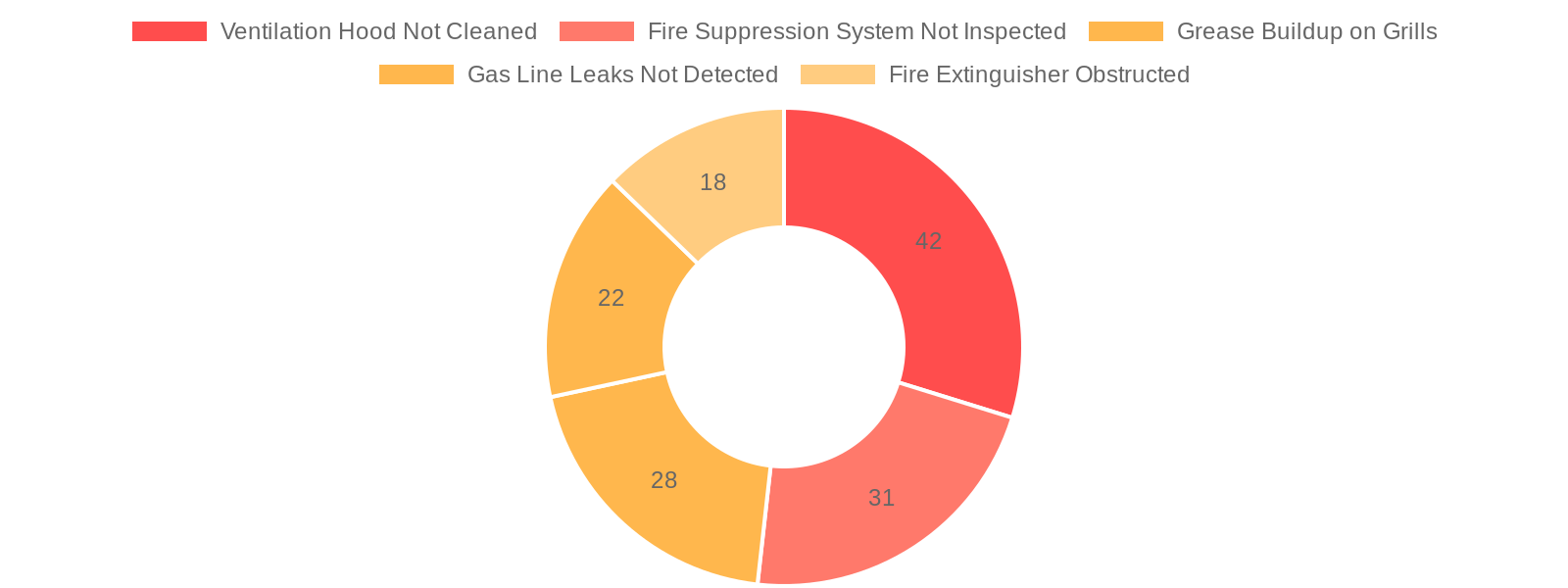
Why This Matters for Your Bottom Line
According to restaurant inspection data from 2025-2026, ventilation hood cleanliness (42%) and fire suppression system maintenance (31%) are the top two violations cited in Korean BBQ-style establishments. These aren’t minor infractions – they can lead to shutdown orders, increased insurance premiums, and serious legal exposure. Building a consistent daily pre-service routine is the simplest way to protect your investment and keep your doors open.
For more insight on setting up your service floor safely, check out our guide on restaurant equipment maintenance best practices.
Pro Tip: Print this checklist and laminate it. Assign one opening staff member daily to initial each item and log it in a binder. That signed record becomes your proof of due diligence during health inspections.
Common Mistakes Business Owners Make When Opening Korean BBQ
Opening a Korean BBQ restaurant is an exciting venture, but the path is littered with costly missteps that can turn a dream concept into a smoke-filled nightmare. Here are the most common mistakes we’ve seen business owners make – and how to avoid them.
1. Underestimating Ventilation Requirements
Nothing kills a Korean BBQ experience faster than a dining room that looks like a fog machine went rogue. Many first-time owners assume a standard commercial hood will suffice, only to find tables of coughing customers waving napkins at the ceiling. Korean BBQ generates exponentially more smoke and grease than a typical flat-top griddle – you need exhaust hoods rated for at least 100-150 CFM per linear foot of grill, with ducted systems venting directly outdoors. Skimping here doesn’t just hurt ambiance; it violates health codes and drives customers away before they’ve even tasted your short ribs.
2. Choosing Cheap Grills That Fail Within Months
We’ve seen it happen: an owner buys budget-friendly tabletop grills to save on startup costs, only to have burners fail, heating zones go uneven, and griddle surfaces warp within six to twelve months. Industry data shows that reputable commercial Korean BBQ grills should last 7-10 years with proper care, but cheap alternatives often fail at a rate of 15% or higher after just five years. You end up replacing equipment yearly – far more expensive than investing in quality from the start. Understanding how does a korean bbq work properly begins with choosing grills built for the constant high-heat, high-grease environment unique to this cuisine.
3. Ignoring Local Fire Code Nuances Specific to Korean BBQ
Korean BBQ isn’t just another grill concept in the eyes of fire marshals. NFPA 96 mandates specific ventilation and fire suppression standards for commercial cooking operations, and many cities – from Los Angeles to New York – enforce additional local requirements for tabletop grilling. We’ve heard horror stories of restaurants passing initial inspections only to be shut down weeks later because their hood system wasn’t ducted to code or their fire suppression system wasn’t rated for Class K fires (the kind produced by cooking oils and grease). One restaurateur in Chicago had to tear out his entire ceiling just to add proper ducting – a $40,000 lesson he wishes he’d learned upfront.
4. Not Budgeting for Ongoing Maintenance
Here’s a number that surprises most new owners: professional duct cleaning every three to six months runs $150-$400 per visit, with filter replacements adding another $50-$100 each time. Skip those cleanings, and grease buildup becomes a serious fire hazard – not to mention that your exhaust system loses efficiency, making the dining room smokier and your AC bills higher. Annual maintenance costs for Korean BBQ ventilation typically land between $1,800 and $5,000, and neglecting this line item is one of the quickest ways to fail a fire inspection or, worse, face a grease-fed kitchen fire.
5. Understaffing for the Labor-Intensive Service Model
Korean BBQ is not a set-it-and-forget-it dining experience. Each table requires a server who’s part grill master, part safety monitor, and part flavor consultant – monitoring cook times, swapping grates, refilling banchan, and keeping an eye on temperature. Industry research shows Korean BBQ concepts require approximately 30% more staff per square foot than traditional restaurants, with labor costs running 25% higher than casual dining. Owners who try to run a full dining room with bare-bones staffing quickly discover overwhelmed employees, burnt meat, frustrated guests, and terrible Yelp reviews.
Avoiding These Pitfalls Starts with the Right Partner
Fortunately, none of these mistakes are inevitable. Working with experienced equipment partners who understand the unique demands of Korean BBQ – like Zoomlion’s commercial-grade ventilation and grill systems – can save you thousands in emergency repairs, compliance fines, and lost revenue. When you partner with pros who already know how does a korean bbq work properly, you skip the trial-and-error phase and open with confidence. For more insights on building a successful Korean BBQ concept, explore our guide on how to choose the right all-you-can-eat Korean BBQ setup or check out menu strategies from established Korean BBQ locations.
Building a Safer, More Successful Korean BBQ Business
As we’ve explored throughout this guide, launching and operating a Korean BBQ restaurant is a high-reward venture – but it demands serious investment in the right equipment, ventilation infrastructure, and fire safety systems. The sizzling tabletop grills that captivate diners also generate intense heat, grease-laden smoke, and unique fire risks that standard kitchen setups simply cannot handle. Getting it right means the difference between a thriving establishment and a costly safety liability.
At the heart of it all, understanding how does a Korean BBQ work – from airflow dynamics to grease management and heat distribution – is the very foundation of business success. Whether you’re opening a new location or upgrading an existing one, every decision about hood systems, exhaust fans, fire suppression units, and ductwork must be guided by that fundamental knowledge. The restaurants that invest wisely in these systems create safer environments for guests and staff, maintain compliance with NFPA 96 standards, and ultimately deliver the authentic dining experience that keeps customers coming back.
Partner with Expertise You Can Trust
This is where Zoomlion steps in. Founded in 1992, Zoomlion is a globally recognized, dual-listed (A+H shares) high-tech equipment manufacturer with decades of experience engineering commercial kitchen solutions. Our product line includes commercial kitchen fire suppression systems certified to NFPA 17A and UL 300 standards, high-efficiency grease filters, smart-monitored exhaust hoods, and complete ventilation packages designed specifically for high-volume cooking operations like Korean BBQ. With installations in over 2,000 commercial kitchens since 2023 and a global network of service partners, Zoomlion brings the technical expertise and proven equipment that Korean BBQ restaurateurs need to succeed.
Whatever stage you’re at – planning your dream Korean BBQ concept, retrofitting an existing space with compliant ventilation, or scaling up your operations – we’re ready to help you build a kitchen that’s safe, efficient, and built to last.
Don’t wait – contact us today to discuss your needs, request a quote, or learn more about how we can support your mission to protect lives and property.