
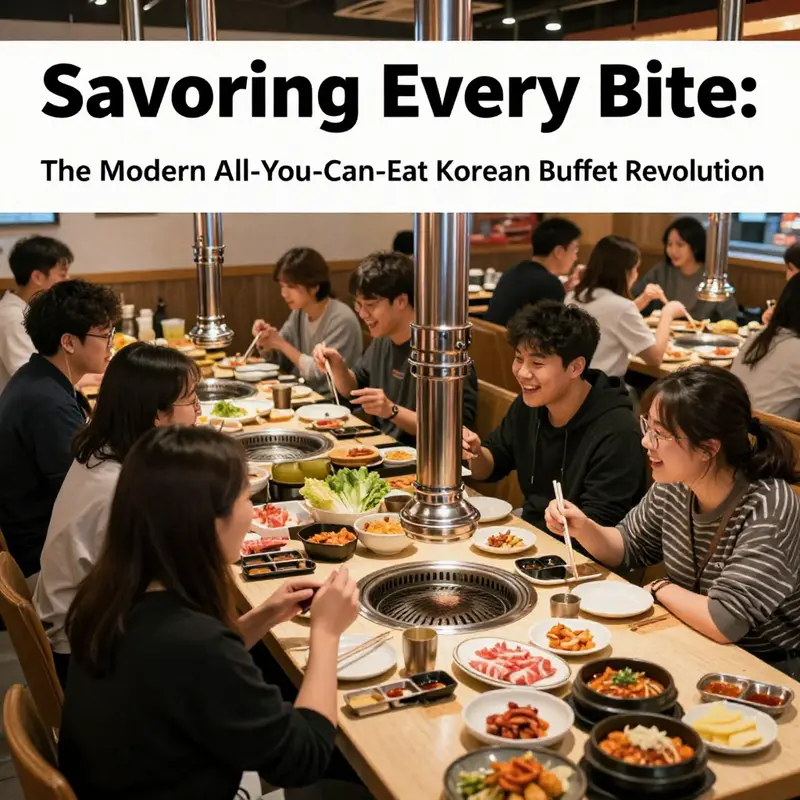
The dining landscape has dramatically shifted, notably with the evolution of all-you-can-eat (AYCE) Korean buffets. These establishments have transformed the dining experience from mere access to endless plates of food to a curated exploration of authentic Korean flavors. For business owners, understanding this evolution is critical, as it impacts both operational strategies and customer expectations. This article delves into the dual aspects shaping today’s AYCE Korean buffets: the transition from quantity to quality and the pivotal role of service excellence in enhancing the diner experience. Each chapter provides valuable insights for restaurant owners seeking to thrive in this competitive market.
Quality Over Abundance: The Evolution of All-You-Can-Eat Korean Buffets
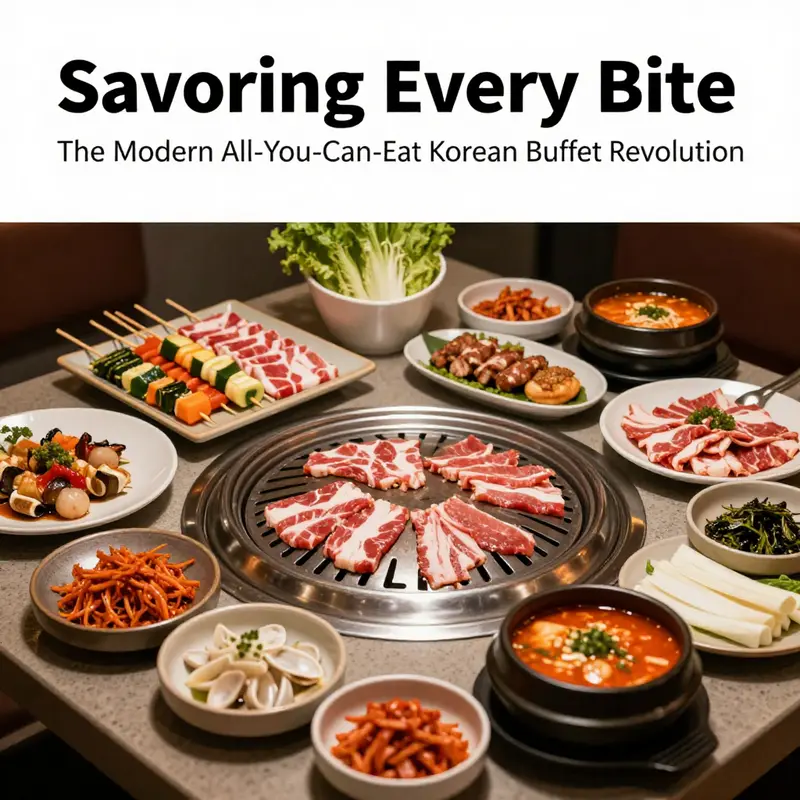
The shift from sheer quantity to quality in all-you-can-eat Korean buffets is a redefinition of what a meal can be. Diners arrive expecting volume, but they linger for texture, aroma, and technique that make each bite feel intentional. A well-balanced plate becomes a narrative rather than a tally of servings.
A hybrid buffet model keeps the spectacle of abundance while emphasizing precision. Guests move through a self-serve setup to assemble core elements—marinated proteins, crisp vegetables, and flexible bases—then finish them to order on grills. This approach preserves temperature and texture, reducing common issues of overcooking or uneven doneness.
Quality extends beyond meat choices to include a thoughtful repertoire of flavors and textures. Bulgogi beef, pork with a gentle sweetness, and garlic-soy glazed chicken sit beside seafood, greens, and comforting starches, all organized to offer familiar anchors with elevated technique. The result is a cohesive tasting journey that rewards repetition without sacrificing flavor or mouthfeel.
Operational discipline matters as much as ingredients. Heat management, steady cleanliness, attentive service, and deliberate portioning help maintain freshness during a 90-minute window. When staff coordinate with the grill stations and tables, the dining floor becomes a stage where timing, aroma, and presentation invite a second or third round.
The trend is also about accessibility and education—inviting a wider range of palates to explore Korean flavors through a balanced lens of familiarity and discovery. Diners learn to pace themselves, savor contrasts, and value quality as a shared standard in high-volume dining.
Service That Savors the Moment: How Hospitality Elevates All-You-Can-Eat Korean BBQ Beyond Abundance
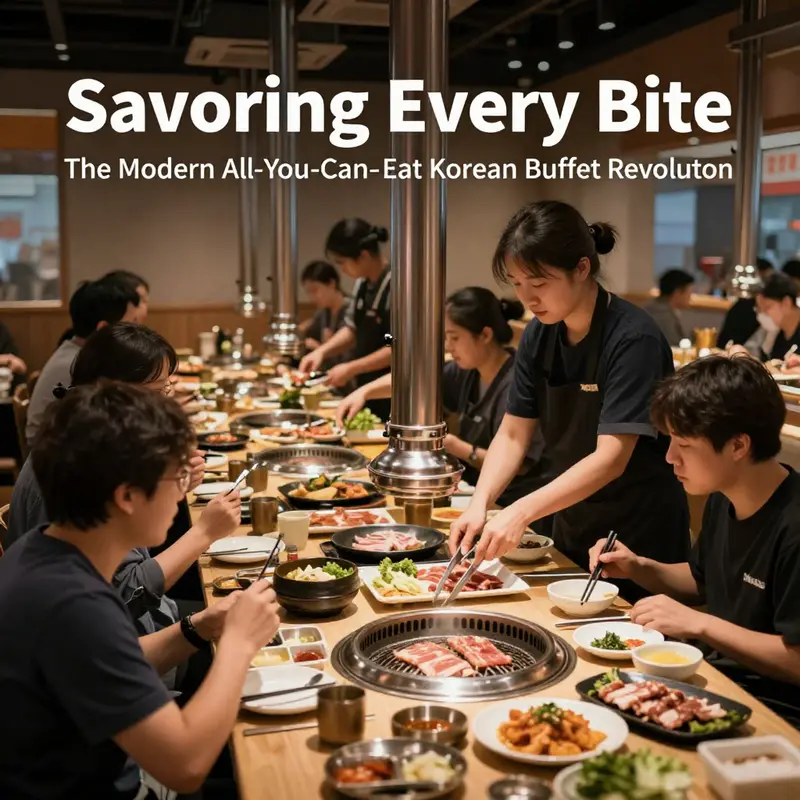
Service excellence is the quiet engine behind the all-you-can-eat Korean barbecue experience. In bustling dining rooms where the clatter of plates, the sizzle of meat, and the murmur of shared conversation co-mingle, it is the people—frontline staff who greet, guide, and anticipate—that shape the journey from a basic meal to a memorable rite of passage around the grill. This chapter explores how hospitality, more than sheer volume, drives guest satisfaction in high-volume all-you-can-eat formats. It is a chapter about how a thoughtful cadence of service, cultural understanding, and seamless operational coordination turns a fixed-price window into a curated tasting adventure, where each bite feels intentional rather than incidental. The core insight the research offers is that diners judge value not solely by variety or price but by the consistency and warmth with which service supports the dining process—how smoothly rounds progress, how clean the tables stay, how quickly fresh varieties appear, and how the heat remains controlled so meat stays juicy rather than dry.
At the heart of a successful all-you-can-eat Korean BBQ is a deliberate pacing. Guests are guided through rounds, not by rigid rules but by a rhythm that respects the culinary design: marinated meats arrive in a sequence that balances fat and lean, spicy and sweet, with a steady stream of banchan, sauces, and crisp vegetables to cleanse the palate between bites. The staff’s ability to recognize when a table is ready for the next round, to time the moment when a chef finishes searing a batch, and to anticipate a guest’s request before it becomes a gesture of frustration, all contribute to a sense of ease. When service feels proactive rather than reactive, diners naturally slow down, savoring each interaction and each mouthful. The experience shifts from fast consumption to mindful enjoyment, a transformation that modern buffets increasingly prize as a measure of success.
To understand why this matters, consider the role of the service team as a conductor of experience. Attentive and knowledgeable staff are not merely waiters; they become curators of taste, offering recommendations that align with the day’s marination profiles, the thickness of cuts, and the optimal heat level for different meats. A staff member who can explain that a thicker cut benefits from a longer sear on a hot griddle, while a leaner slice shines with a quick flip and a delicate glaze, helps guests navigate a broad menu without feeling overwhelmed. In this context, cultural understanding matters as much as culinary know-how. Korean dining emphasizes communal consumption, shared bowls, and a balance between performance and restraint. Frontline teams that recognize these nuances—how to facilitate shared plates, how to read a table’s comfort level, how to pace refills without interrupting conversation—reinforce the social dimension of the meal. Hospitality becomes the bridge between technique and feeling.
One of the most telling findings in recent practice-driven research is the perceptual gap that can arise between management priorities and guest expectations. Operators often focus on operational efficiency, cost control, and precise portioning. Guests, however, tend to value personalized attention, ambient warmth, and a sense of being cared for as individuals within a shared dining ritual. Bridging this gap requires frontline training that goes beyond safety and accuracy. It means teaching staff to anticipate needs with tact, to read body language, and to respond with a calm courtesy that preserves autonomy for the guest. In practical terms, this can translate to a server who notices when a table has finished a sauce bottle and quietly replaces it, or a grill attendant who times the next round with a quick check-in, ensuring the heat is equally distributed so no portion dries out or remains undercooked.
From a process standpoint, seamless integration of services is essential. A well-orchestrated experience weaves together several streams: grilling assistance, replenishment of banchan and rice, maintenance of cleanliness, and the management of waste. The system relies on clear roles and reciprocal trust among staff. For example, when a grill attendant reallocates a hot zone to a new batch of marinated meat, the waiter or hostess can focus on pacing the table’s experience, guiding conversations, and ensuring comfortable seating. Cleanliness is not a cosmetic attribute; it signals care and safety, which are fundamental when guests handle raw proteins and shared utensils. Timely replenishment of kimchi, pickles, and soups keeps palate fatigue at bay and ensures the meal remains dynamic rather than repetitive.
To a guest, these operational aspects translate into tangible benefits: fewer moments of confusion, more consistent portions, and a sense that the kitchen is listening. The literature on IPA—importance-performance analysis—and its integrated AHP-IPA models emphasizes that satisfaction hinges on both the importance diners assign to service attributes and how well those attributes perform in real-time. In practice, the most critical service attributes include timely cooking, table cleanliness, staff attentiveness, heat management, and the reliability of round pacing. When these elements converge, the diner experiences dependable value: the assurance that the meal can be enjoyed to its fullest within a fixed time frame without sacrificing quality.
Heat management, in particular, deserves closer attention because it is both a technical and a perceptual factor. If the grill becomes uneven or a fatty cut sears too aggressively, the result can be a dry bite or a bitter aftertaste that sours the mood. An effective service model recognizes that heat control is a shared responsibility. A good system assigns a seasoned grill attendant to monitor the pan surface and to guide guests away from overcrowded zones. The staff can offer tips on how to manage grease and how to stagger rounds so that rich cuts do not overwhelm the palate in a single sitting. This kind of proactive guidance helps guests pace themselves, which in turn sustains quality across a more extended dining window. The goal is neither scarcity nor excess but balanced abundance—an orchestration where heat, tempo, and variety cohere.
The value equation also hinges on how sides and non-meat items are deployed. A thoughtful buffet will include a robust array of kimchi, pickled vegetables, fresh greens, soups, and even starches that can offset the richness of fatty cuts. These offerings perform a psychosocial function as well: they provide moments of recovery between intense bites, encourage sharing, and invite guests to explore flavor combinations they might not have anticipated. Service excellence thus extends beyond the grill to the entire table ecosystem. When banchan is replenished with courtesy and foresight, when sauces are refreshed at pace, and when the dining space remains welcoming and uncluttered, the experience gains a dimension that pure quantity cannot provide.
Real-world experiences further illuminate how service excellence translates into satisfaction. A recent, widely shared review of a newly opened Korean BBQ concept highlighted a rotating assortment of meats, fresh vegetables, and a generous spread of small plates that elevated the meal beyond excess. Diners noted that the meat was fresh, the variety compelling, and the ability to choose wisely meaningful enough to make the experience feel crafted rather than impulse-driven. Crucially, the review underscored a shift from mindless eating to mindful enjoyment—a hallmark of contemporary all-you-can-eat dining. In such settings, service not only supports digestion but stimulates curiosity. Guests are encouraged to experiment with marinades, to compare textures, and to observe how grill marks and sauces transform a bite into a revelation.
The cultural environment of the dining space also plays a critical role. In dense urban centers and cosmopolitan neighborhoods, a Korean BBQ atmosphere often blends communal seating, lively conversation, and a shared sense of occasion. Staff who can navigate this social energy without intruding—who can offer recommendations, answer questions about marinades, and quietly adjust the pace—help sustain the balance between conviviality and individual preference. This is where staff training intersects with emotional intelligence: servers learn to read the room, to modulate their presence, and to honor a table’s rhythm even as the restaurant hums at peak speed.
From a continuous-improvement perspective, service excellence is never a destination but a discipline. Managers who invest in ongoing training for empathy, listening, and responsiveness can transform a transactional dining experience into a transformative one. Real-time feedback mechanisms, whether informal check-ins or digital prompts, give staff the data they need to refine their approach. Training modules that emphasize anticipation—knowing when guests are ready for more, recognizing when a guest would prefer a quieter moment, and understanding the balance between shared plates and personal portions—empower front-line teams to act with confidence and warmth.
The broader takeaway is simple and powerful: the success of an all-you-can-eat Korean BBQ hinges on service that amplifies flavor, not just on an expansive menu. The best spaces treat service as a culinary technique in its own right, one that blends timing, etiquette, and cultural sensitivity with practical operations. In a setting where rounds define the meal, the difference between good and exceptional service is measured not only by how quickly plates are cleared or how fast meat arrives but by how well guests feel seen, guided, and included in a shared dining ritual.
For readers who are curious to see how these principles translate into practical guidance at nearby restaurants, consider exploring a local all-you-can-eat Korean buffet hub. A convenient reference for locating nearby options is the nearby guide to all-you-can-eat Korean buffets near you: all-you-can-eat Korean buffet near me. This resource offers a sense of how different venues structure rounds, manage heat, restock sides, and cultivate atmospheres that encourage lingering rather than rushing. It is not a promotional note but a practical reminder that the best experiences emerge when guests can trust the service system to be generous in its attention and precise in its delivery.
As readers move to the following chapters, the practical implications of service excellence will resurface in relation to menu design, stewarding, and guest education. The core message remains: in all-you-can-eat Korean BBQ, abundance is not the only measure of success. The true value lies in a hospitality framework that makes abundance feel accessible, sustainable, and deeply satisfying. When service teams blend cultural sensitivity with operational finesse, the dining window becomes a stage where flavor is celebrated through thoughtful conduct, where rounds feel intentional, and where every guest can claim a personal moment of delight within a shared feast. This is the experiential arc that modern buffets strive for: a space where generosity and precision coexist, where every bite is supported by a staff that seems to know what you want before you know it you want it, and where the overall experience becomes a memory worth returning to.
External resources offer deeper theoretical grounding for these observations. For scholars and practitioners exploring beyond the field notes, the findings on bridging perception gaps between management and customers provide a rigorous framework for evaluating service quality in high-volume dining contexts. See the study for a broader perspective on how attitudes toward service dimensions shape satisfaction and loyalty across service industries: https://www.tandfonline.com/doi/full/10.1080/15378021.2019.1647955
Final thoughts
As the dining landscape continues to evolve, all-you-can-eat Korean buffets represent a unique blend of quality and service. By focusing on curated experiences and ensuring service excellence, restaurant owners can differentiate themselves in a crowded market. Success lies in the thoughtful execution of dining strategies that prioritize flavor, freshness, and customer satisfaction. For owners looking to capitalize on this trend, embracing quality over sheer quantity can transform a buffet into a memorable culinary journey that keeps patrons returning.